BusinessRoles and Participants
A BusinessRole represents an entity (or a class of entities) of the real world, physical or legal, a person, a group of persons, a corporation. Examples of BusinessRoles: “Financial Institution”, “Automated Clearing House”, “Central Securities Depository”.
A Participant is a functional role performed by a BusinessRole in a particular BusinessProcess or BusinessTransaction. Examples of Participants: the “user” of a system, “debtor”, “creditor”, “investor”.
The relationship between BusinessRoles and Participants is many-to-many. One BusinessRole can be involved as different Participants at different moments in time or at the same time. Examples of BusinessRoles: “user”, “debtor”, “creditor”, “investor”. Different BusinessRoles can be involved as the same Participant.
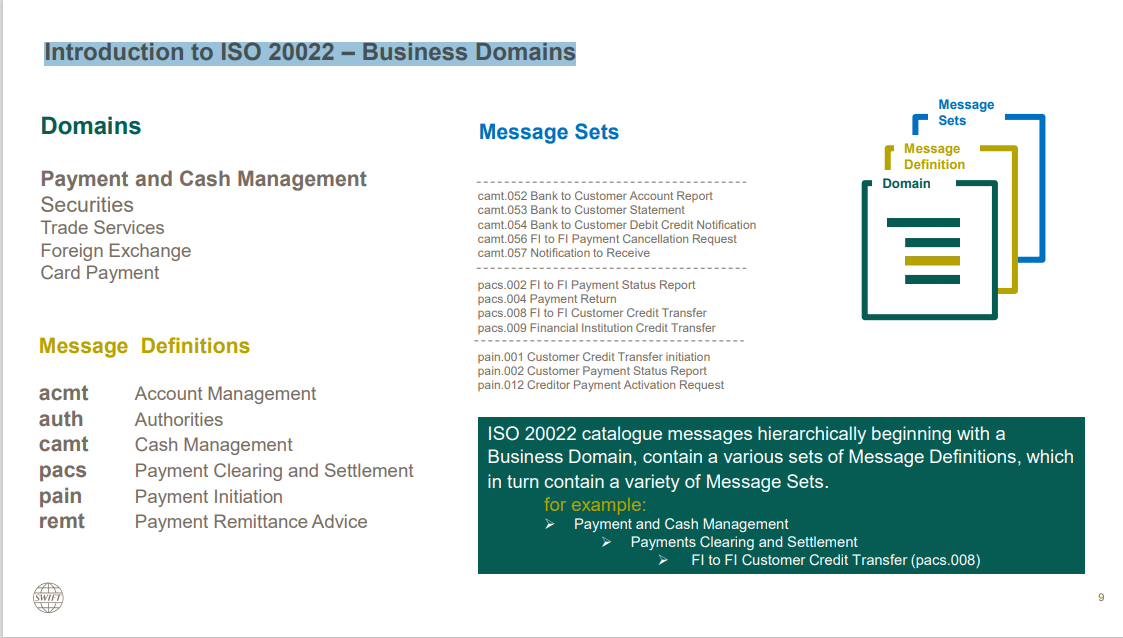
In the context of Payments Clearing and Settlement the high-level BusinessRoles and typical Participants can be represented as follows:
Participants and Business Roles Definitions
Participants
| Description |
Definition |
| Debtor |
Party that owes an amount of money to the (ultimate) creditor. In the context of the payment model, the debtor is also the debit account owner. |
| Creditor |
Party to which an amount of money is due. In the context of the payment model, the creditor is also the credit account owner. |
| Ultimate Debtor |
Ultimate party that owes an amount of money to the (ultimate) creditor. |
| Ultimate Creditor |
Ultimate party to which an amount of money is due. |
| Debtor Agent |
Financial institution servicing an account for the debtor. |
| Creditor Agent |
Financial institution servicing an account for the creditor. |
| Forwarding Agent |
Financial institution that receives the instruction from the initiating party and forwards it to the next agent in the payment chain for execution. |
| Initiating Party |
Party initiating the payment to an agent. In the payment context, this can either be the debtor (in a credit transfer), the creditor (in a direct debit), or a party that initiates the payment on behalf of the debtor or creditor. |
| Account Owner |
Party that legally owns the account. |
| Account Servicer |
Party that manages the account on behalf of the account owner, that is manages the registration and booking of entries on the account, calculates balances on the account and provides information about the account. |
| Payment Clearing Agent (Instructing Agent) |
Agent that instructs the next party in the payment chain to carry out the payment/instruction. |
| Payment Settlement Agent (Instructed Agent) |
Agent that executes the instruction upon the request of the previous party in the chain (either an agreement party, or a clearing agent). |
| Intermediary Agent |
Agent between the debtor’s agent and the creditor’s agent. There can be several intermediary agents specified for the execution of a payment. |
Business Roles
| Description |
Definition |
| Financial Institution |
Organisation established primarily to provide financial services. |
| Clearing System |
Specifies the system which plays a role in the clearing process. |
| Party |
Entity involved in a payment. |
Business Roles and Participants Table
| BusinessRole |
Financial Institution |
Clearing System |
Party |
| Debtor |
|
|
X |
| Creditor |
|
|
X |
| Ultimate Debtor |
|
|
X |
| Ultimate Creditor |
|
|
X |
| Debtor Agent |
X |
X |
|
| Creditor Agent |
X |
X |
|
| Forwarding Agent |
X |
X |
|
| Initiating Party |
|
|
X |
| Account Owner |
X |
|
X |
| Account Servicer |
X |
X |
|
| Payment Clearing Agent |
X |
X |
|
| Payment Settlement Agent |
X |
X |
|
| Intermediary Agent |
X |
X |
|