What is the difference between pac.008 or pac.009 core, adv and cov messages?

PAC.008, PAC.009, and PAC.009 messages are all part of the SWIFT MT (Message Type) category for Payments Clearing and Settlement systems. These messages are used for the exchange of funds between financial institutions. Here’s a breakdown of the differences:

  1. PAC.008 (Payment Clearing and Settlement System – Core):
  • PAC.008 is used for the exchange of core payment instructions.
  • It typically contains basic information about the sender, receiver, and the payment amount.
  • It is commonly used for domestic payments or simple cross-border payments where no additional information is required.
  1. PAC.009 (Payment Clearing and Settlement System – Advice):
  • PAC.009 is used for the exchange of advice or notification of a payment.
  • It is typically sent by the payer’s bank to the payee’s bank to provide information about a payment made.
  • It may include details such as the payment reference, amount, currency, and date of the payment.
  1. PAC.009 (Payment Clearing and Settlement System – Cover):
  • PAC.009 is used for the exchange of cover payment instructions.
  • It is typically used when an intermediary bank is involved in the payment process.
  • It provides instructions for the intermediary bank to make the payment on behalf of the sender to the final recipient.
  • It may contain details about the intermediary bank, the ultimate beneficiary, and the payment amount.

In summary, PAC.008 is used for core payment instructions, PAC.009 (Advice) is used for payment notifications, and PAC.009 (Cover) is used for cover payment instructions involving an intermediary bank. The choice of message type depends on the specific requirements of the payment transaction and the involvement of intermediary banks.
how to install Universal Standards Archive Package for MAS library within Alliance Access and IPLA Connector for Transformation called Rosetta?

If you’re looking to streamline your banking operations and enhance connectivity within your organization, installing the Universal Standards Archive Package for MAS Library within Alliance Access and IPLA Connector for Transformation (Rosetta) is crucial. This powerful combination enables seamless data transformation and communication between your systems, ensuring efficient and secure transactions.

To get started, follow these step-by-step instructions for a successful installation:

  1. Gather the necessary resources: Before diving into the installation process, make sure you have the Universal Standards Archive Package for MAS Library and the IPLA Connector for Transformation (Rosetta) software packages at hand. These can be obtained from your trusted software provider.
  2. Prepare the environment: Ensure that your system meets the necessary requirements for installation. This includes having the appropriate hardware specifications and the supported operating system version. Check the documentation provided with the software packages for detailed information.
  3. Begin with Alliance Access installation: If you haven’t already installed Alliance Access, start by completing this step. Install and configure Alliance Access according to the specific guidelines provided by your software vendor. Be sure to follow the recommended best practices to ensure a smooth setup.
  4. Install the MAS Library: The next step is to install the Universal Standards Archive Package for MAS Library. Launch the installation wizard and carefully follow the on-screen instructions. Select the desired installation options and directories as recommended by the software vendor.
  5. Proceed with Rosetta installation: Now, it’s time to install the IPLA Connector for Transformation, commonly known as Rosetta. Run the installation wizard provided with the software package and carefully follow the prompts. Pay attention to any specific configurations required during the installation process.
  6. Configure the integration: Once both the MAS Library and Rosetta installations are completed successfully, it’s time to configure the integration between them and your existing systems. This step involves setting up communication channels, configuring mapping rules, and ensuring proper data flow between Alliance Access and Rosetta.
  7. Test and validate: Before fully deploying the solution, perform thorough testing. Validate the data transformation process, message exchange, and overall functionality. Identify and resolve any issues encountered during testing to ensure optimal performance.
  8. Deploy and monitor: Once everything is working as expected, proceed with the full deployment of the Universal Standards Archive Package for MAS Library within Alliance Access and IPLA Connector for Transformation (Rosetta). Monitor the system closely for any potential errors or performance issues, and address them promptly to maintain smooth operations.

By following these steps, you can successfully install the Universal Standards Archive Package for MAS Library within Alliance Access and IPLA Connector for Transformation (Rosetta). Unlock the potential of seamless data transformation and communication in your banking infrastructure, elevating efficiency and security to new heights.

Please note that the installation process may vary slightly depending on the software versions and configurations. Always consult the documentation provided by your software vendor for precise instructions.

What are Like-for-Like++ ISO 20022 messages?

Like-for-Like++ ISO 20022 messages, also known as L4L++ ISO 20022 messages, are a crucial part of the financial messaging landscape. These standardized messages enable seamless communication and data exchange between financial institutions, facilitating a wide range of banking operations.

These messages follow the ISO 20022 standard, which provides a comprehensive framework for the development of messaging standards in the financial industry. ISO 20022 is designed to enhance interoperability, efficiency, and transparency in financial transactions. L4L++ ISO 20022 messages adhere to this standard and are specifically used for like-for-like transactions, where the sender and receiver have a direct correspondent banking relationship.

The format and fields of L4L++ ISO 20022 messages are meticulously defined to ensure consistency and accuracy in data transmission. The messages incorporate a wide array of information, including payment instructions, beneficiary details, remittance information, and transaction status updates. Each field within the message has a predefined purpose and format, ensuring that the data is correctly interpreted by the recipient.

These messages play a crucial role in enabling efficient cross-border payments, funds transfers, and other financial transactions. By utilizing the ISO 20022 standardization and the L4L++ format, financial institutions can streamline their operations, reduce errors, and enhance the overall banking experience for their customers.

In summary, Like-for-Like++ ISO 20022 messages offer a standardized and efficient means of communication in the financial industry. With their well-defined formats and fields, these messages enable seamless data exchange between financial institutions, facilitating smooth and secure transactions. By adopting these messages, banks can optimize their operations and provide enhanced services to their customers.

MAS Electronic Payment System (MEPS+)

The MAS Electronic Payment System (MEPS+) of Singapore is a real-time gross settlement (RTGS) system that allows for the processing and settlement of high-value Singapore dollar interbank funds transfers. It is operated by the Monetary Authority of Singapore (MAS) and began operating in 2006.

What SWIFT message formats and network are used by the MAS Electronic Payment System (MEPS+) of Singapore ?

MEPS+ has a number of features that make it a highly efficient and reliable system, including:

  • Use of SWIFT message formats and network: MEPS+ uses SWIFT message formats and network, which allows for greater straight-through processing and cost savings by banks.
  • Advanced queue management capabilities: MEPS+ has advanced queue management capabilities that allow it to handle a large number of transactions efficiently.
  • Automated collateralised intra-day liquidity facilities: MEPS+ has automated collateralised intra-day liquidity facilities that allow banks to access funds quickly and efficiently.
  • Automated gridlock detection and resolution: MEPS+ has automated gridlock detection and resolution capabilities that help to prevent and resolve any potential gridlocks in the system.

In addition to these features, MEPS+ is also highly secure and reliable. It is backed by the MAS and has a proven track record of success.

Here are some of the benefits of using MEPS+:

  • Speed: MEPS+ is a real-time system, which means that funds are transferred between banks immediately.
  • Security: MEPS+ is a highly secure system with multiple layers of security protection.
  • Reliability: MEPS+ has a proven track record of reliability and uptime.
  • Efficiency: MEPS+ is a highly efficient system that can handle a large number of transactions quickly and accurately.

MEPS+ is used by a wide range of customers, including banks, financial institutions, corporations, and government agencies. It is an essential part of Singapore’s financial infrastructure and plays a vital role in the smooth and efficient functioning of the country’s economy.

What is the difference between different payment ids in iso20022?

The ISO 20022 messaging standard plays a crucial role in the world of international payments, ensuring seamless communication between financial institutions. Within this standard, there are several payment identification fields that serve distinct purposes.

Let’s start with the InstructionIdentification. This identifier, represented by the <InstrId> tag, helps to uniquely identify an instruction within a message. It is specific to each transfer and can be used for tracking and reconciliation purposes.

Next, we have the EndToEndIdentification, enclosed by the <EndToEndId> tag. This payment identifier is crucial for end-to-end tracking of a transaction. It remains the same throughout the entire payment chain, from the originating bank to the beneficiary’s bank. Its purpose is to provide a reference point, allowing both parties to link the payment to a specific transaction.

Finally, we come to the Transaction Identification. Enclosed by the <TxId> tag, this identifier distinguishes each transaction within a message. It serves as a unique reference number, enabling banks to identify and process payments accurately.

These different payment identification fields serve essential functions within ISO 20022, ensuring transparency, traceability, and accuracy throughout the payment journey. Financial institutions rely on these identifiers to facilitate smooth payment processing and enhance the overall efficiency of cross-border transactions.

In conclusion, understanding the nuances and differences between the various payment identification fields in ISO 20022 is crucial for financial institutions to effectively communicate and process international payments. By adhering to these standards, banks can streamline their operations and provide better service to their customers.

Learn More : Difference between payment IDs in ISO 20022

Give me a practical example of EndToEndIdentification in the ISO20022 pacs.008 ? Who provides the information?

What are the fields of pacs.008 AND the data format of the fields? Give me a practical example?

Understanding the Fields and Data Format of PACS.008

When it comes to processing financial transactions, the PACS.008 message format plays a vital role in the world of payments. In this article, we will explore the fields and data format of PACS.008, providing you with a practical example to enhance your understanding.

The PACS.008 message format is used in the financial industry for the exchange of payment-related information. It encompasses various fields that carry specific data, allowing financial institutions to accurately process and settle payments. Let’s delve into some of the key fields and their data format:

  1. Message Identification (MsgId): This field consists of a unique identifier assigned by the sender of the message. It helps in identifying a specific payment message in case of any inquiries or investigations.
  2. Creation Date Time (CreDtTm): This field indicates the date and time when the message was created. It enables proper timestamping and tracking of the payment initiation.
  3. Payment Information (PmtInf): The PmtInf field encapsulates the payment related details, including the payment amount, currency, and the method through which the payment should be executed, such as credit transfer or direct debit.
  4. Debtor Information (Dbtr): This field holds the information about the person or entity making the payment. It typically includes details such as the debtor’s name, address, and account number.
  5. Creditor Information (Cdtr): The Cdtr field contains the details of the person or entity receiving the payment. It provides information about the creditor’s name, address, and account number.
  6. Payment Details (PmtDtls): This field holds specific information regarding the payment transaction, such as the purpose of the payment, reference numbers, or any related remittance information.

Now, let’s look at a practical example of a PACS.008 message:

MsgId: PACS008-20211231-001
CreDtTm: 2021-12-31T09:15:00
PmtInf: 
  - PmtInfId: ABC123456
    PmtMtd: TRF
    PmtInfAmt: 1000.00 USD
    BtchBookg: true
    Dbtr:
      Name: John Doe
      AccountNo: 1234567890
    Cdtr:
      Name: Jane Smith
      AccountNo: 0987654321
    PmtDtls: Invoice Payment

In this example, the PACS.008 message is created on December 31, 2021, at 09:15:00. The payment information includes an amount of 1000.00 USD, with John Doe being the debtor and Jane Smith as the creditor. The payment details specify that it is an invoice payment.

Understanding the fields and data format of PACS.008 is crucial for financial institutions and payment processors to seamlessly handle payment transactions. It ensures accuracy, traceability, and efficient processing of payments, benefiting both businesses and individuals alike.

Note: It is important to consult the official documentation and regulatory guidelines to ensure adherence to the latest standards when working with PACS.008 messages.

SEPA credit Transfer pain.001.001. what its fields or xml elements? Give a practical example?

The SEPA Credit Transfer pain.001.001 message is used for initiating credit transfers in the Single Euro Payments Area (SEPA). It contains various XML elements that provide information about the payment transaction. Here are some common fields or XML elements found in the pain.001.001 message:

  1. GroupHeader: Contains information about the message group, such as the message identification, creation date and time, and the number of transactions in the group.
  2. InitgPty: Provides details about the party initiating the payment, including their name and address.
  3. PaymentInformation: Represents a single payment transaction within the message. It contains information such as the payment amount, currency, execution date, and payment method.
  4. Debtor: Contains details about the debtor, including their name and address.
  5. DebtorAccount: Specifies the debtor’s account details, such as the account number and the financial institution where the account is held.
  6. Creditor: Provides information about the creditor, including their name and address.
  7. CreditorAccount: Specifies the creditor’s account details, such as the account number and the financial institution where the account is held.
  8. RemittanceInformation: Includes any additional information related to the payment, such as an invoice number or a payment reference.

Here is a practical example of a pain.001.001 message:

<Document xmlns="urn:iso:std:iso:20022:tech:xsd:pain.001.001.03">
  <CstmrCdtTrfInitn>
    <GrpHdr>
      <MsgId>201908010001</MsgId>
      <CreDtTm>2019-08-01T09:30:00</CreDtTm>
      <NbOfTxs>2</NbOfTxs>
    </GrpHdr>
    <PmtInf>
      <PmtInfId>123456789</PmtInfId>
      <PmtMtd>TRF</PmtMtd>
      <ReqdExctnDt>2019-08-05</ReqdExctnDt>
      <Dbtr>
        <Nm>John Doe</Nm>
        <PstlAdr>
          <StrtNm>Main Street</StrtNm>
          <BldgNb>10</BldgNb>
          <PstCd>12345</PstCd>
          <TwnNm>City</TwnNm>
          <Ctry>GB</Ctry>
        </PstlAdr>
      </Dbtr>
      <DbtrAcct>
        <Id>
          <IBAN>GB29NWBK60161331926819</IBAN>
        </Id>
      </DbtrAcct>
      <CdtTrfTxInf>
        <PmtId>
          <EndToEndId>ABC123</EndToEndId>
        </PmtId>
        <Amt>
          <InstdAmt Ccy="EUR">100.00</InstdAmt>
        </Amt>
        <Cdtr>
          <Nm>Jane Smith</Nm>
          <PstlAdr>
            <StrtNm>First Avenue</StrtNm>
            <BldgNb>5</BldgNb>
            <PstCd>67890</PstCd>
            <TwnNm>City</TwnNm>
            <Ctry>GB</Ctry>
          </PstlAdr>
        </Cdtr>
        <CdtrAcct>
          <Id>
            <IBAN>GB30NWBK40000012345678</IBAN>
          </Id>
        </CdtrAcct>
        <RmtInf>
          <Ustrd>Invoice 12345</Ustrd>
        </RmtInf>
      </CdtTrfTxInf>
    </PmtInf>
  </CstmrCdtTrfInitn>
</Document>

In this example, the pain.001.001 message initiates a credit transfer from the debtor (John Doe) to the creditor (Jane Smith). The payment amount is 100.00 EUR, and the payment reference is “Invoice 12345”. The message includes details such as the message identification, creation date and time, and the number of transactions in the group.

Please note that this is just a simplified example, and the actual content and structure of the pain.001.001 message may vary depending on the specific implementation and requirements.

What ie pain.001 interbank customer credit transfer initiation? What are its field and how data should be entered in the fields? How its fields are mapped into pacs.008?

The pain.001 interbank customer credit transfer initiation is a standard format used in the banking industry to initiate interbank customer credit transfers. This format defines a set of fields that must be populated with relevant data to ensure a successful transaction. Let’s take a closer look at the fields and their significance:

  1. Message Identification (MIR): This field uniquely identifies the message and is used for tracking and reconciliation purposes.
  2. Initiating Party: This field specifies the details of the entity initiating the credit transfer, such as their name, address, and identification number.
  3. Debtor: This field contains information about the entity making the payment, including their name, address, and account details.
  4. Creditor: This field provides details about the entity receiving the funds, including their name, address, and account information.
  5. Amount: This field specifies the amount of money to be transferred.
  6. Currency: Here, the currency in which the payment is made is specified.
  7. Purpose of Payment: This field indicates the reason for the credit transfer, such as invoice payment or salary disbursement.

When mapping the fields from pain.001 to pacs.008, certain transformations occur to ensure compatibility between the two formats. For example, the initiating party and debtor information from pain.001 will be mapped to the instructing party and debtor agent fields in pacs.008, respectively.

It is important to enter the data accurately into the respective fields to ensure a smooth transfer of funds. Any errors or inconsistencies may result in delays or failed transactions. Therefore, banks and financial institutions must adhere to the standards defined in pain.001 and pacs.008 to ensure efficient and secure interbank customer credit transfers.

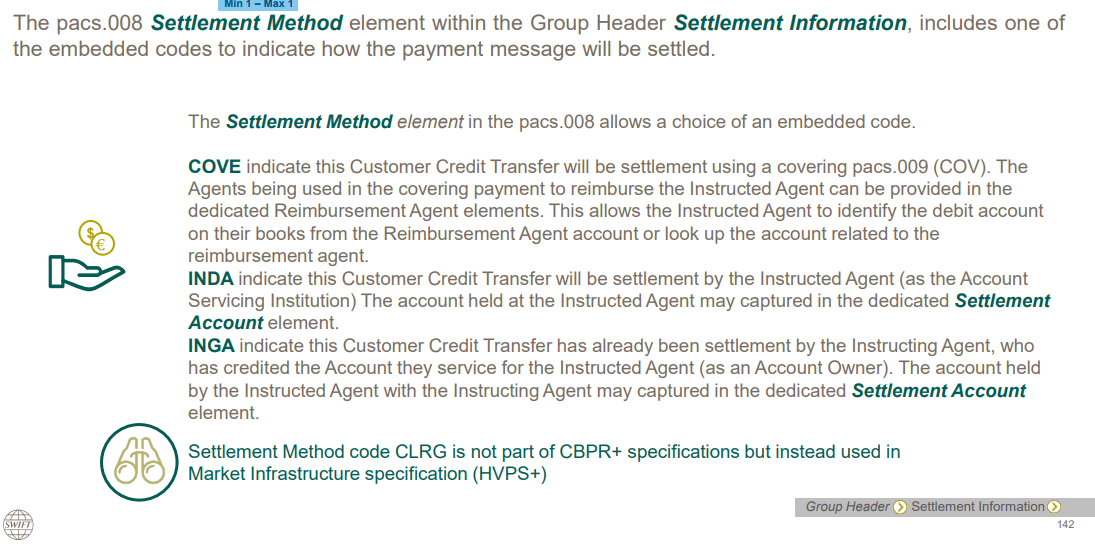
Pacs Settlement method

The pacs messages introduce the Settlement Method element within the Group Header Settlement Information. Settlement refers to the Agent whose role is to act as an Account Servicing Institution i.e. owns the account and provides service to the customer (Account Owner). The Account Owner can be an Agent or another Party.

Traditionally an interbank account relationship may have been referred to as a Nostro/Vostro relationship or an Agent’s account held on another Agent’s books/ another Agent’s account held on my books. Typically the commonality of this can be simplified to the Agent who provides the official Account statement is servicing the account and therefore is the Agent responsible for performing the settlement.

Why is it so important to understand which Agent Services the account ? In ISO 20022, much like the legacy FIN process, each leg of a payment has a settlement component. Commonly one of these settlement legs occurs over a Market Infrastructure, who typically owns or instructs the settlement between the two Market Infrastructure participant Agents at a national Central Bank.

In this case the Central Bank services both the Instructing Agent and Instructed Agent accounts which is represented by CLRG in the Settlement Method of a pacs message. In a number of business Use Cases there are examples of additional legs, which may occur prior to or after a potential Market Infrastructure, where an Agent is responsible for the role to service an account and perform settlement of that leg. This role is important as it determines the subsequence message behaviour

Understand ISO20022 Business Roles and Participants

BusinessRoles and Participants

A BusinessRole represents an entity (or a class of entities) of the real world, physical or legal, a person, a group of persons, a corporation. Examples of BusinessRoles: “Financial Institution”, “Automated Clearing House”, “Central Securities Depository”.

A Participant is a functional role performed by a BusinessRole in a particular BusinessProcess or BusinessTransaction. Examples of Participants: the “user” of a system, “debtor”, “creditor”, “investor”.

The relationship between BusinessRoles and Participants is many-to-many. One BusinessRole can be involved as different Participants at different moments in time or at the same time. Examples of BusinessRoles: “user”, “debtor”, “creditor”, “investor”. Different BusinessRoles can be involved as the same Participant.

In the context of Payments Clearing and Settlement the high-level BusinessRoles and typical Participants can be represented as follows:

Participants and Business Roles Definitions

Participants

Description Definition
Debtor Party that owes an amount of money to the (ultimate) creditor. In the context of the payment model, the debtor is also the debit account owner.
Creditor Party to which an amount of money is due. In the context of the payment model, the creditor is also the credit account owner.
Ultimate Debtor Ultimate party that owes an amount of money to the (ultimate) creditor.
Ultimate Creditor Ultimate party to which an amount of money is due.
Debtor Agent Financial institution servicing an account for the debtor.
Creditor Agent Financial institution servicing an account for the creditor.
Forwarding Agent Financial institution that receives the instruction from the initiating party and forwards it to the next agent in the payment chain for execution.
Initiating Party Party initiating the payment to an agent. In the payment context, this can either be the debtor (in a credit transfer), the creditor (in a direct debit), or a party that initiates the payment on behalf of the debtor or creditor.
Account Owner Party that legally owns the account.
Account Servicer Party that manages the account on behalf of the account owner, that is manages the registration and booking of entries on the account, calculates balances on the account and provides information about the account.
Payment Clearing Agent (Instructing Agent) Agent that instructs the next party in the payment chain to carry out the payment/instruction.
Payment Settlement Agent (Instructed Agent) Agent that executes the instruction upon the request of the previous party in the chain (either an agreement party, or a clearing agent).
Intermediary Agent Agent between the debtor’s agent and the creditor’s agent. There can be several intermediary agents specified for the execution of a payment.

Business Roles

Description Definition
Financial Institution Organisation established primarily to provide financial services.
Clearing System Specifies the system which plays a role in the clearing process.
Party Entity involved in a payment.

Business Roles and Participants Table

BusinessRole Financial Institution Clearing System Party
Debtor X
Creditor X
Ultimate Debtor X
Ultimate Creditor X
Debtor Agent X X
Creditor Agent X X
Forwarding Agent X X
Initiating Party X
Account Owner X X
Account Servicer X X
Payment Clearing Agent X X
Payment Settlement Agent X X
Intermediary Agent X X