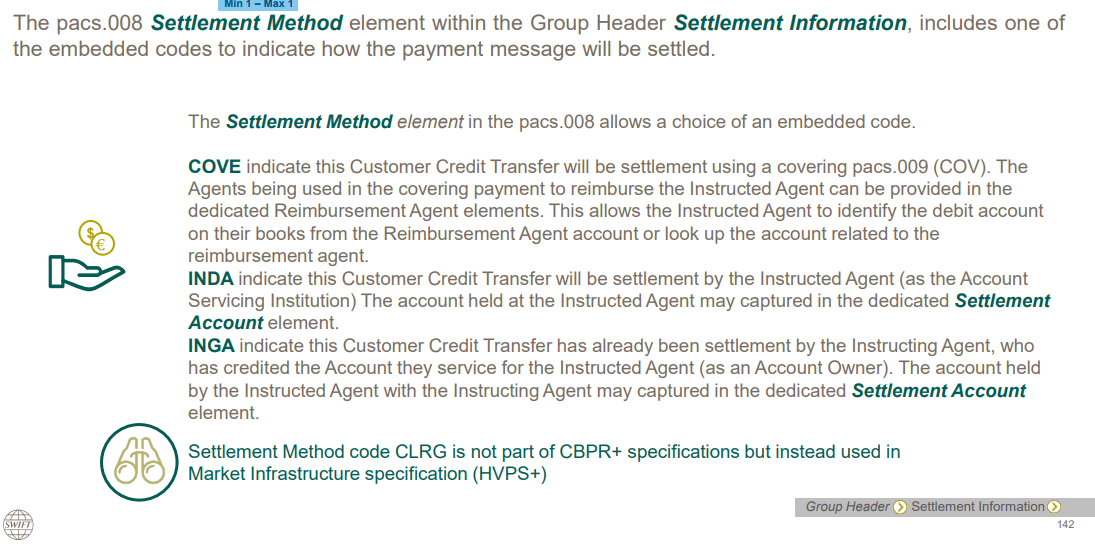
The pacs messages introduce the Settlement Method element within the Group Header Settlement Information. Settlement refers to the Agent whose role is to act as an Account Servicing Institution i.e. owns the account and provides service to the customer (Account Owner). The Account Owner can be an Agent or another Party.
Traditionally an interbank account relationship may have been referred to as a Nostro/Vostro relationship or an Agent’s account held on another Agent’s books/ another Agent’s account held on my books. Typically the commonality of this can be simplified to the Agent who provides the official Account statement is servicing the account and therefore is the Agent responsible for performing the settlement.
Why is it so important to understand which Agent Services the account ? In ISO 20022, much like the legacy FIN process, each leg of a payment has a settlement component. Commonly one of these settlement legs occurs over a Market Infrastructure, who typically owns or instructs the settlement between the two Market Infrastructure participant Agents at a national Central Bank.
In this case the Central Bank services both the Instructing Agent and Instructed Agent accounts which is represented by CLRG in the Settlement Method of a pacs message. In a number of business Use Cases there are examples of additional legs, which may occur prior to or after a potential Market Infrastructure, where an Agent is responsible for the role to service an account and perform settlement of that leg. This role is important as it determines the subsequence message behaviour
